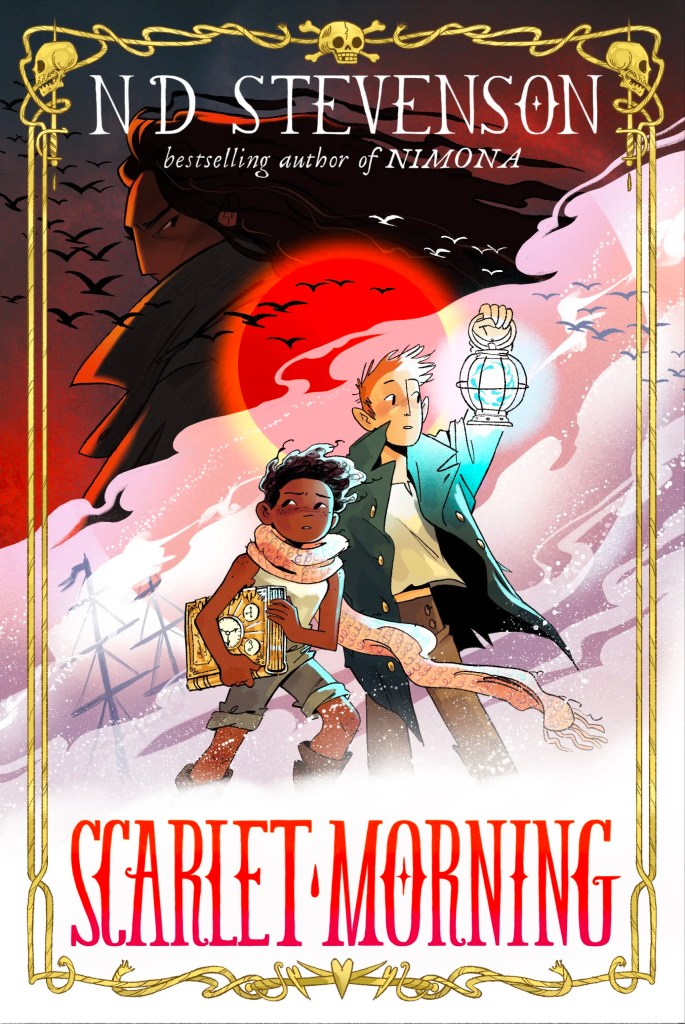
Scarlet Morning by ND Stevenson is a middle grade novel set in the fantasy world of Dickerson’s Sea where the sea is sour, salt covers everything, and for Viola and Wilmur, nothing interesting ever happens until, one day, Captain Chase of the Calamary Rose agrees to take them on her ship. Throughout the novel, Stevenson employs strong imagery to build the world of Dickerson’s Sea:
“Viola stared up in fearful awe at the curl of ocean hanging above their heads, frozen at the very point of its breaking…”
“And beyond it were more waves, as far as the eye could see…the raging sea had petrified and turned to solid crystal in the space of a single moment” (150-151).
Early in the novel, Viola and Wilmur learn about a pirate named Scarlet Morning through their caregiver, Hestur, who asserts that Scarlet Morning killed a queen named Hail Mary Meridian leading to a pirate massacre and storm that ruined the sea. When Viola discovers the crew of the Calamary Rose are actually former pirates, she panics. After an attack from a “whale-thing” leaves her to travel alone with Chase, who has been revealed to be Scarlet Morning, Viola must work through her biases and discover that there’s more to the story than she’s been told. Throughout their journey, Viola comes to know and respect the captain as Stevenson uses pirates to touch on themes of identity, community, and longing to be part of something bigger.
Stevenson uses his background as a graphic novelist to create engaging illustrations while also pushing the conventions of the novel, frequently playing with space on the page. In an interview with BookPage, Stevenson said he was inspired by A Series of Unfortunate Events’ use of unusual text spacing and empty space, seeing “the page itself as kind of a framing mechanism.” Blank spaces embedded in quotation marks, for example, convey a character’s inability to hear the speaker’s words. This tactic is frequently used in dream sequences to convey the chaos and otherworldly confusion of Viola’s dreams. In addition to impressionistic prose, Stevenson uses the backdrop of the page to enhance plot elements, such as when Viola is “plunged into nothingness” and the text is seemingly submerged into the sea as black ink rises up the page. Also notable is a section of documents for the reader to investigate, for which Stevenson used a broken typewriter to create authenticity.
Stevenson’s familiar illustration style complements his first prose novel. When asked by Publishers Weekly how he chose which scenes and moments to illustrate, Stevenson said “You have to be careful about what you show when you’re illustrating prose. Otherwise, the words and the pictures end up fighting each other. You don’t want to go against the image that the reader is already building in their heads. I wanted the illustrations to be a stepping stone in getting the person reading it to conjure that larger image themselves.”
The origin of Scarlet Morning is particularly appealing to middle grade readers, as the characters came from a “collaborative game–almost like LARP or D&D” that Stevenson led his friends in as a tween, according to his interview with Publishers Weekly. The author then began writing the book as a teen, which is something he explores through the character of Viola. In an interview with The Gamer, Stevenson, a trans man, said “In the early draft there’s lots of me trying to figure out what adulthood is from a teenage perspective,” and that the characters are “…trying to create a way to survive this world that is pretty hostile towards them, and I think that’s how I felt about the world I grew up in.”
Queer themes are a constant undercurrent to the narrative of piracy and the perception of otherness. At the beginning of the book Hestur says “…but the pirates fled…to unnatural islands with cursed soil where no Civilized person would dare set foot. They built their own kingdoms there – and what foul kingdoms there were…” (5). Rereading this dialogue after finishing the book really underscores the queer themes, particularly related to fear and the stories people tell about trans people. As Chase says to Viola, “whatever story’s recorded first is the one remembered” (161). As Chase says to Viola while recounting the narrative of her alleged murder of the queen, whatever story’s recorded first is the one remembered. Later on, Viola and Chase discuss a story which brings to mind the stories we hear as children to cover the truth of queer relationships or identities: “Well…what about the sisters Cutberta and Elisapie Hirsute, the Cannibal Queens of Rattlebone Cross?” … “Sisters!” snorted Chase. “Is that what they’re saying…they weren’t sisters. They were married,” and “So Cutberta wore a dress and Elisapie wore a fake beard” (172).
As a reader without much knowledge of pirates, I found Stevenson’s interviews discussing his knowledge and interest in them very helpful for understanding the connection to queer themes. As he told BookPage, “Pirates are able to create their whole world on the verges of society, in these blank spaces that are not governable. They can go where no one else can go and they can truly be themselves.” Additionally, in an interview with the blog Smack Dab In the Middle, Stevenson discussed pirate lore being “rife with stories of muddled identity,” such as Jacquotte Delahaye, a probably-fictional pirate who “supposedly faked her own death, lived as a man for ten years, and then went back to presenting as a woman.”
As many children do, Viola clearly longs to belong to something bigger. She says “All the best stories are already over. The world I grew up dreaming about doesn’t exist anymore…” (176). Later on Viola explains what it meant to meet Captain Chase “Then…someone came along, and I knew right away that she was one of the important ones. Being with her felt like standing at the center of the world, and I knew as long as I was there, I wasn’t going to miss anything else. And I felt like…maybe I did matter, just from being near her” (336). As a trans reader, reading a trans author, I see this as a declaration of the importance of queer role models and the desire for community.
I will definitely be recommending Scarlet Morning to middle grade readers! In addition to the protagonist being relatable to any child, the fantasy world created by ND Stevenson is unique, having accompanied him from his own childhood. The illustrations within the novel are engaging, and the creative use of space on the page will be incredibly fun for kids.
References
All hands on deck with ND Stevenson (Koch/BookPage, 2025)
Four Questions for ND Stevenson (Ramirez/Publishers Weekly, 2025)
Interview with ND Stevenson, Author of Scarlet Morning (Schindler/Smack Dab In the Middle, 2025)
ND Stevenson Scarlet Morning Interview: A Pirate Adventure Two Decades In The Making (King/The Gamer, 2025)
 Cian Like Keyin
Leave a comment